Spend enough time around crystal awards, and you start to notice something.
Two pieces can be described the same way, sourced the same way, and even made from the same material, and still look completely different in your hands. That difference is not in the label. It’s in how the piece was made. And for shops working with these materials, it shows up quickly in how the piece behaves during engraving, printing, or finishing.
‘Crystal’ isn’t a specification
Few terms are used more loosely in the awards industry than “crystal.” Clients ask for it. Suppliers offer it. Catalogs are filled with it. But in practice, “crystal” is not a precise material definition. It’s a broad label applied to a range of glass formulations that can vary significantly in clarity, finish, and overall quality.
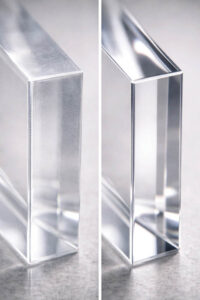 Historically, crystal referred to leaded glass, valued for its weight and brilliance. Today, most awards are lead-free, using high-clarity glass designed to achieve a similar visual effect without the environmental concerns. That shift introduced new terminology:
- K9 crystal
- Optical crystal
- Ultra-clear glass
These terms are widely used but not standardized. As a result, two products described in the same way can look very different in person.
What actually is K9 glass?
K9 is one of the most common materials used in crystal awards today. Technically, it is a high-clarity crown glass similar to optical glass used in lenses and prisms. When produced under controlled conditions, it offers excellent transparency, clean light transmission, and reliable performance for engraving and printing. The key point is this: K9 is not a quality level. It’s a starting point. A well-executed K9 piece can look exceptional. A poorly executed one will not.
Optical crystal: Upgrade or just a label?
“Optical crystal” is often presented as a higher-end alternative to K9. In some cases, that reflects tighter process control and better finishing. In others, it’s simply a different label applied to similar material. There is no universal definition. In practice, the difference is less about chemistry and more about execution. Two pieces described as “optical crystal” can look completely different. The reason comes down to how they are made.
- Cutting and shaping: Waterjet cutting defines the shape, but it does not define the finish. Cut edges are typically rough and slightly opaque until they are polished.
- Edge polishing: This is one of the most important steps in the process. Polishing restores clarity to the material. Properly finished edges appear sharp, reflective, and clean under light. Inconsistent polishing leaves a faint haze, softens edges, and reduces overall clarity. Under certain lighting, you’ll sometimes see a faint softness along an edge where polishing wasn’t fully resolved. It’s subtle, but once you notice it, it seems obvious.
- Surface decoration: Sandblasting diffuses light and creates a frosted effect. Printing adds color and contrast. Each interacts differently with the material.
- Variability: Even within the same production run, variability can enter at multiple stages. Small differences in polishing pressure, time, or technique can affect edge clarity. Handling during finishing can introduce subtle haze or micro-abrasions.
A more practical way to think about K9 quality
For buyers and providers, it’s more useful to think in terms of execution rather than labels:
Well-executed K9
- High clarity, no visible haze or distortion
- Crisp, highly polished edges
- Consistent geometry across pieces
- Clean, controlled engraving or printing
Lower-quality K9
- Slight internal haze or distortion
- Softer or uneven edge polishing
- Minor inconsistencies between pieces
- Engraving that appears overly heavy or poorly resolved
At a glance, both may be called “crystal.” Under real light, the difference is obvious.
Subsurface laser etching
Subsurface laser etching produces an internal image by focusing laser energy at precise points inside the crystal. Each point creates a microscopic fracture that alters how light passes through that location. By placing thousands, and often tens of thousands, of these points in three-dimensional space, a complete image is formed that appears to float within the material.
The quality of the result depends on how those points are controlled. Density, spacing, and depth all influence how the image interacts with light. In some cases, you’ll see faces or fine detail start to flatten out as density increases. The image becomes clearer at a glance, but less convincing as an object. Well-executed subsurface etching appears subtle and dimensional. The image reveals itself as light moves through the crystal, rather than reading as a solid white form.
How the image is actually built
Subsurface etching is not a continuous engraving process. It is a point-based system. Each visible element inside the crystal is created one point at a time using a computer-controlled laser system. These systems position the laser in three dimensions, focusing energy below the surface without affecting the exterior. The result is a structure made up of thousands of discrete internal points. This has two important implications.
The trade-off in photorealistic etching
Modern subsurface engraving systems make it possible to create highly detailed, photorealistic images inside crystal. By increasing point density and layering multiple passes, operators can produce images that read clearly at first glance. These approaches are widely used in consumer and promotional applications, where immediate visual recognition is important. However, there is a trade-off. As point density increases, the image becomes more opaque. Instead of interacting subtly with light, it begins to read as a dense white mass within the material. The internal structure becomes less dimensional, and the natural clarity of the crystal is reduced.
What works (& what doesn’t) in subsurface etching
What works
- Controlled point density
- Thoughtful use of depth and spacing
- Simpler, more intentional compositions
- Alignment between material clarity and image style
What doesn’t
- Overly dense, photorealistic fills
- Large solid areas of white “etch”
- Poor depth mapping or uneven spacing
- Designs that ignore how light behaves in the material
Dense, photorealistic etching may look impressive in isolation, but under real light it often reduces depth and clarity compared.
A note on equipment
The capabilities described here are closely tied to the laser systems used. Subsurface engraving relies on specialized equipment designed to place points precisely within the material. Newer hybrid systems, such as the xTool F2 Ultra UV, are expanding access to these techniques for smaller shops. That said, machine selection is its own topic. Differences in laser type, optics, and control systems have a direct impact on engraving quality. It’s worth evaluating equipment separately rather than assuming all systems produce similar results.
Consumer versus high-end applications
Many of the techniques demonstrated in widely available videos are optimized for consumer products such as photo gifts, novelty crystal blocks, and high-contrast internal images. These approaches are effective and commercially viable. In consumer applications, the image is often the product. In higher-end work, the object itself still has to hold up.
In applications such as deal toys and high-end recognition pieces, the objective is different. The goal is not maximum visual impact at first glance, but a more controlled, refined object that continues to read well under closer inspection and over time.
Sourcing materials
Most crystal used in awards and recognition products originates from Asia, particularly China. K9 glass and similar optical-grade materials are typically produced there, then either fabricated into finished pieces or exported as cut or semifinished components. Providers in North America often work by importing fully finished products, or precut material that is further processed locally.
The perceived difference between “domestic” and “overseas” product is usually not about where the base material comes from. It comes down to how the material is finished, how tightly the process is controlled, and how quality is verified before delivery. Two providers may be working from similar base material and produce very different results. As with any sourcing decision, the outcome depends less on geography alone and more on how a given facility operates within that environment. This is why two pieces described the same way can come from very different production settings and produce very different results. GP
A note on UV ‘testing’
Some informal methods are sometimes used to try to distinguish between types of glass, including observing how a piece reacts under ultraviolet light. These tests are occasionally demonstrated in a shop or online and can be interesting from a material standpoint. However, they are not a reliable or standardized way to identify K9 versus “optical crystal.” Glass used in these applications is typically lead-free and chemically similar across categories. Any visible reaction under UV light is more likely influenced by trace elements or production variables than by the material label itself. For practical purposes, these kinds of tests are secondary. Clarity, edge quality, consistency, and engraving behavior remain the most reliable indicators of overall quality.
How to evaluate a sample before approval
The most reliable way to assess quality is not the description, it’s the sample. Before approving a piece, evaluate:
- Clarity: free of haze, bubbles, or distortion
- Edge quality: sharp, polished, and clean
- Straight-line test: no warping through the material
- Consistency: pieces match across a run
- Engraving quality: light, dimensional, and controlled
Design and process alignment
Material selection is only part of the equation. The best results come from aligning design with process:
- Fine detail requires controlled etching density
- Subsurface engraving behaves differently than surface decoration
- Certain shapes demand higher polishing standards
When these elements align, even simple designs feel intentional and refined. When they do not, even high-end materials can produce disappointing results.